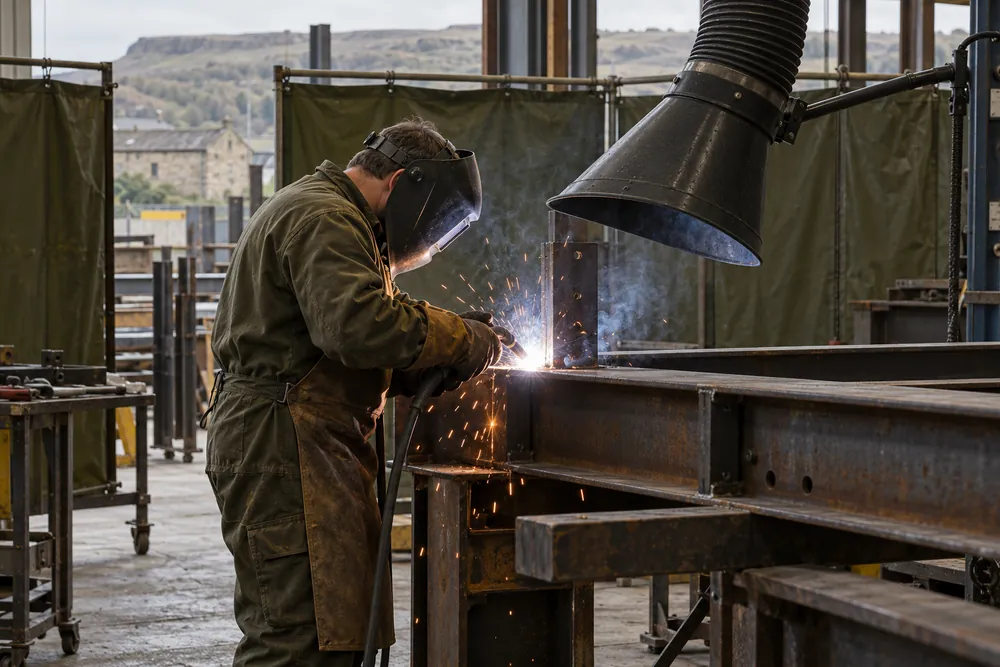
What The Work Involves
Welding joins metal through a controlled process selected for the material, thickness and joint design. Fabrication brings that joining work together with cutting, preparation and assembly. A finished weld needs to meet the drawing and acceptance criteria, not simply look tidy from the outside.
We welcome enquiries for workshop-built welded frames, brackets and assemblies, alongside commercial repair requirements that can be properly assessed. Send photographs for context, plus drawings or material details where available. A photograph cannot confirm material grade, hidden defects or the remaining strength of a damaged component.
The appropriate welding process depends on access, position, material and the specification. Do not choose a process solely by the equipment available on site. The joint preparation, consumables, welding procedure and inspection scope need to suit the intended duty and any governing project standard.
When You Need This Service
Welding may be required when assembling new steelwork, modifying a designed connection or repairing a component after its failure has been investigated. A repair should address why the crack or damage occurred. Repeatedly welding over the same defect can leave the original loading, fatigue or alignment issue unresolved.
For work on plant and machinery, isolate the equipment and involve the responsible maintenance or engineering person. For structural steel, obtain an engineer’s repair detail where needed. Safety-critical parts and unknown materials may need specialist assessment, testing or replacement rather than a local weld repair.
Details Worth Resolving Early
A useful welding brief states the parent material, thickness, joint configuration and required acceptance level. It should identify distortion limits, important dimensions and any surfaces that must remain free of spatter or coating damage. If the assembly has been painted or contaminated, preparation needs to be considered before the work is planned.
Workshop work can offer better control of position, preparation and access than a difficult site repair. Site welding needs a separate review of fire risk, ventilation, weather and nearby activities. Some jobs are better removed for workshop assessment, while others should not be welded until the design or material uncertainty has been resolved.
Agree the inspection requirements before the joint is made. Visual checks can identify some defects but cannot prove the condition of every internal feature. If non-destructive testing is specified, state the method, extent and reporting requirement so it can be planned into the sequence.
Standards And Project Responsibilities
Welding fume requires control under the Control of Substances Hazardous to Health Regulations 2002. HSE guidance calls for suitable controls, including extraction where appropriate and respiratory protection where needed. A welding helmet alone does not control exposure to fume.
Structural welding should follow the project execution specification, including the relevant BS EN 1090-2 requirements. Welding quality arrangements may refer to the applicable part of BS EN ISO 3834. The required procedures, welder qualifications and inspection records depend on the work and must be verified for that scope.
For site hot work, agree the permit arrangements, isolation, fire precautions and safe working area with the premises team. Construction projects also need coordination under CDM 2015. A permit is one control within the safe method of work, not a substitute for assessing the repair and its surroundings.
How The Work Is Planned
Assess The Requirement
Provide the material, dimensions, duty and reason for welding. For a repair, include the failure history and identify any responsible engineer or equipment specialist.
Agree The Method
Confirm the joint detail, preparation, procedure and inspection requirements. Decide whether the work belongs in a workshop or can be safely planned at the site.
Prepare And Weld
Prepare the surfaces and assemble the joint to the approved detail. Control alignment, welding sequence and distortion alongside the required safety measures.
Inspect And Record
Check the completed work against the acceptance criteria. Provide the records and testing reports specified in the order, with any restrictions on return to service.
What Goes Into A Steelwork Quote
Welding cost depends on joint preparation, access, material, position and weld size. A short weld run on a Derby workshop assembly can still require substantial preparation and inspection. Removing coatings, setting up an assembly, managing distortion and carrying out inspection all need time within a realistic quotation.
Site work may also involve permits, isolation and protecting nearby equipment. Testing and engineering assessment can be separate services. Give the planned access arrangements and acceptance requirements when enquiring so the quotation describes a usable repair or fabrication package rather than an unexplained allowance for welding hours.
Your Questions Answered
Can Cracked Steel Be Welded Safely?
Cracked steel needs an assessment before a weld repair can be recommended. Material, loading, crack location and the reason for failure all affect the decision. Structural or safety-critical components may need an engineer’s repair design and testing, while some damaged parts are better replaced than returned to service with a local repair.
Can Welding Be Carried Out On Site?
Site welding can be considered when access, isolation, fume control and fire precautions are suitable. Provide details of the premises, nearby activities and permit arrangements before the work is planned. The component and joint still need an approved method, and some tasks are better completed under controlled workshop conditions instead.